
The Value of Saving a Life | Clifton Surf Lifesaving Club Operational Social Value and Benefit–Cost Ratio Report
How Volunteer Clifton Lifeguards Generate Millions in Public Safety Value on Cape Town’s Beaches
Every summer, thousands of people arrive at Clifton’s beaches chasing freedom, sunshine and the ocean. Few ever realise how much unseen work goes into keeping those beaches safe. Behind every calm beach day is a team of volunteer lifesavers preventing drownings before they happen, responding to emergencies within seconds and standing watch over one of South Africa’s busiest and most iconic coastlines.
This report estimates the operational, social and economic value generated by Clifton Surf Lifesaving Club through volunteer lifesaving services, emergency response, drowning prevention, medical response and preventative public safety interventions across Clifton 1st, 2nd, 3rd and 4th Beaches in Cape Town, South Africa.
The methodology used in this report is based on the principles contained within the PKF Octagon Lifesaving South Africa Report 2025, which estimated the social and economic contribution of lifesaving nationally. The PKF report applied Cost Benefit Analysis and Value of Statistical Life principles to estimate the value generated by lifesaving activities.
This Clifton report applies a Value of Statistical Life aligned model using category-based incident values and severity classifications to quantify the measurable public safety and community value generated through volunteer lifesaving operations.
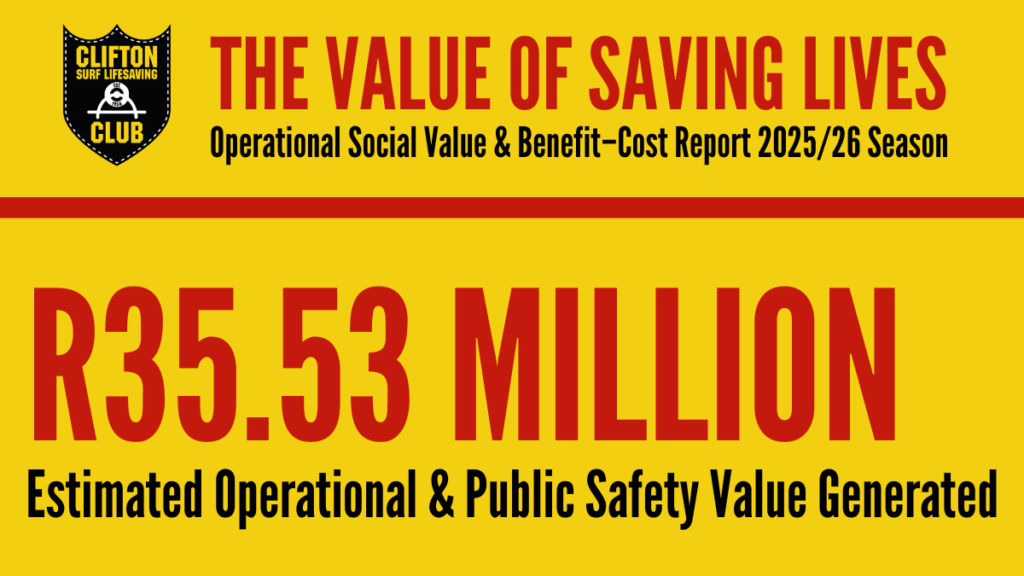
During the reporting period, the club delivered an estimated R35.53 million in measurable social and economic value, while achieving zero drownings under active patrol conditions. Across 5,079.5 volunteer duty hours, 19 rescues, 86 medical first aid incidents, 2 successful CPR resuscitations and 286 preventative interventions, the findings demonstrate the scale of protection delivered on Cape Town’s coastline every season.
The results show that volunteer lifesaving is not simply community service. It is critical public safety infrastructure delivering substantial social and economic value to one of South Africa’s most heavily used public beaches.
Operational Overview
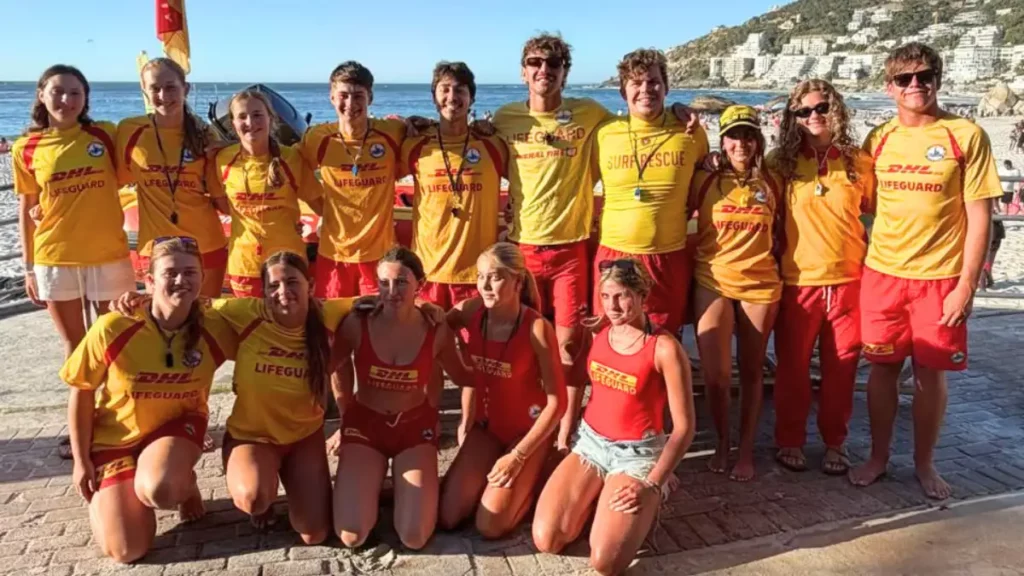
Clifton Surf Lifesaving Club provided volunteer lifesaving and public safety services across:
- Clifton 1st Beach
- Clifton 2nd Beach
- Clifton 3rd Beach
- Clifton 4th Beach
The club’s operational responsibilities included:
- Active beach patrols
- Emergency rescue response
- Medical first aid treatment
- Drowning prevention operations
- Public education and beach safety engagement
- Coastal hazard monitoring
- Preventative intervention and risk mitigation
The club operated throughout the reporting period using volunteer patrol teams supported by rescue craft, lifesaving equipment, medical resources and operational infrastructure.
Operational Statistics
| Metric | Total |
| Lifeguards | 139 |
| Total Duty Days | 50 |
| Total Duty Hours | 5,079.5 |
| IRB Operational Hours | 52.75 |
| Drownings | 0 |
| Total Rescues | 19 |
| Total Medical Incidents | 86 |
| Total Incidents | 21 |
| Successful CPR Resuscitations | 2 |
| Total Preventative Actions | 286 |
The club achieved zero drownings during the reporting period while maintaining active patrol coverage, rapid response capability and preventative public safety operations across the Clifton beachfront.
Preventative Actions and Public Safety Impact
Preventative intervention formed a major component of the club’s operational contribution. These actions reduced the probability of incidents occurring before emergency response became necessary.
During February and March 2026, Clifton Surf Lifesaving Club piloted its new BeachSafe Tracker system to formally capture preventative intervention data.
As a result, the preventative action totals reflected in this report only represent two months of recorded data within the broader reporting period and are therefore likely materially understated relative to the club’s full seasonal preventative contribution.
Preventative Action Totals
| Category | Total |
| Public Education and Engagement | 68 |
| Water and Hazard Monitoring | 48 |
| Behavioural Interventions | 66 |
| Signage and Communication | 58 |
| Supervision and Presence | 24 |
| Environmental and General Safety | 22 |
| TOTAL PREVENTATIVE ACTIONS | 286 |
Examples of preventative interventions included:
- Rip current warnings
- Hazard identification
- Unsafe swimming intervention
- Rock jumping prevention
- Child supervision intervention
- Alcohol-related intervention
- Public safety briefings
- Area closures
- Signage checks and updates
- Whistle and verbal warnings
These interventions form a critical component of modern coastal risk management and significantly reduce the probability of rescues, medical emergencies and drowning incidents occurring.
Referencing international drowning prevention literature, including guidance from the World Health Organization global investment case for drowning prevention, the club assigns a conservative value of:
R500 per preventative intervention
This value reflects the contribution of early risk identification, public education, behavioural intervention and hazard prevention in reducing the likelihood of rescue, injury or drowning incidents.
Preventative operations remain one of the most important and under-recognised components of modern coastal safety management.
Medical First Aid Responses
In addition to rescues and emergency incidents, the club responded to 86 medical first aid cases during the reporting period.
These incidents included:
- Fractures
- Sprains
- Cuts and abrasions
- Stings and bites
- Grazes
- Sunburn-related treatment
These medical interventions contributed significantly to:
- Improved public safety outcomes
- Reduced escalation to emergency medical services
- Reduced healthcare burden
- Faster injury management and stabilisation
- Improved beach user wellbeing and reassurance
Volunteer lifesavers therefore perform an important frontline public health and emergency support function in addition to traditional rescue services.
Methodology
This report applies a Value of Statistical Life aligned social value methodology based on the principles used within the PKF Octagon Lifesaving South Africa Report 2025.
The methodology estimates the measurable social and economic value generated through volunteer lifesaving operations using category-based incident values aligned to public safety risk severity.
For Clifton Surf Lifesaving Club, the following value categories were included:
- Volunteer labour contribution
- Rescue, CPR and medical response value
- Preventative intervention value
- Operating expenditure
The rescue, CPR and medical response category includes:
- General first aid incidents
- Standard rescues
- Severe rescues
- Near drownings
- Spinal injury rescues
- Successful CPR resuscitations
The methodology intentionally adopts conservative assumptions while remaining operationally defensible and aligned with internationally recognised public safety valuation principles.
Value of Statistical Life
The Value of Statistical Life (VSL) is an economic measure used to estimate the value society places on reducing the risk of death.
VSL methodologies are commonly used in:
- Public health policy
- Infrastructure planning
- Transport safety
- Environmental economics
- Emergency services analysis
- Cost benefit assessment
Drawing on available South African and international Value of Statistical Life literature — including research from the Organisation for Economic Co-operation and Development, South African public health economic studies and Sub-Saharan African health valuation research — this report applies a South African Value of Statistical Life assumption of:
R10 million
This value is used as the basis for assigning category-based economic values to severe rescue incidents, CPR resuscitations and high-risk drowning prevention outcomes.
Incident Category Values
Incident values were grouped into severity categories aligned with the PKF Octagon methodology.
The assigned values reflect the relative severity, fatality risk profile and potential medical escalation associated with each incident type.
Incident Category Value Table
| Category | Value Used |
| Preventative Action | R500 |
| Minor First Aid Incident | R5,000 |
| Standard Rescue | R150,000 |
| Severe Rescue | R1,500,000 |
| Near Drowning | R3,000,000 |
| Spinal Injury Rescue | R5,000,000 |
| Successful CPR Resuscitation | R10,000,000 |
Higher category values were assigned to incidents involving elevated risk of fatality, catastrophic injury or significant emergency escalation.
Economic Value Assumptions
Volunteer Labour Contribution
Volunteer patrol hours were valued using the City of Cape Town lifeguard hourly rate.
| Metric | Value |
| Total Duty Hours | 5,079.5 |
| Hourly Rate | R100.07 |
| Volunteer Labour Value | R508,305 |
This reflects the significant unpaid contribution made by volunteer lifesavers toward public safety service delivery along the Cape Town coastline.
Rescue, CPR and Medical Response Valuation
Incident Valuation Table
| Incident Type | Quantity | Value per Incident | Total Value |
| General First Aid Incidents | 86 | R5,000 | R430,000 |
| Standard Rescues | 13 | R150,000 | R1,950,000 |
| Severe Rescue | 1 | R1,500,000 | R1,500,000 |
| Near Drownings | 2 | R3,000,000 | R6,000,000 |
| Spinal Injury Rescue | 1 | R5,000,000 | R5,000,000 |
| Successful CPR Resuscitations | 2 | R10,000,000 | R20,000,000 |
Total Rescue, CPR and Medical Response Value
R34,880,000
These assigned values reflect:
- Avoided fatality probability
- Reduced emergency escalation
- Avoided healthcare burden
- Public safety value generated through intervention
- Preserved life and productivity outcomes
- Reduced pressure on emergency response systems
The CPR and severe incident valuations remain aligned with international public health and Value of Statistical Life methodologies referenced throughout the report.
Preventative Action Valuation
Preventative interventions were assigned a conservative operational public safety value.
| Metric | Value |
| Total Preventative Actions | 286 |
| Value per Intervention | R500 |
| Total Preventative Value | R143,000 |
Preventative interventions reduce incident probability before emergency response becomes necessary and remain one of the most cost-effective forms of public safety delivery.
Because preventative intervention tracking only formally commenced during the BeachSafe Tracker pilot period, the preventative value reflected in this report is likely materially understated relative to full seasonal operations.
Total Economic Benefit
Measurable Social and Economic Value Generated
| Category | Value |
| Volunteer Labour Contribution | R508,305 |
| Rescue, CPR and Medical Response Value | R34,880,000 |
| Preventative Intervention Value | R143,000 |
| Total Economic Benefit | R35,531,305 |
The estimated measurable social and economic value generated by Clifton Surf Lifesaving Club during the reporting period is therefore:
R35,531,305
Operating Expenditure
Operational Cost Summary
| Metric | Value |
| Total Operating Expenditure | R1,696,859 |
This operating expenditure includes:
- Club operating costs
- Equipment and fuel
- Insurance
- Medical supplies
- Repairs and maintenance
- Salaries and wages
- Statutory lifesaving fees
- Training
- Operational infrastructure and administration
These expenditures represent the operational cost required to maintain safe and effective volunteer lifesaving capability across the Clifton beachfront.
Benefit–Cost Ratio
The Benefit–Cost Ratio compares the total measurable economic value generated by the club against the expenditure required to deliver those services.
Benefit–Cost Analysis
| Metric | Value |
| Total Economic Benefit | R35,531,305 |
| Total Operating Expenditure | R1,696,859 |
| Net Social Benefit | R33,834,446 |
| Benefit–Cost Ratio | 20.94 |
This means that for every:
R1 invested into Clifton Surf Lifesaving Club
approximately:
R20.94 in measurable social and economic value
was generated for the community.
Conclusion
Based on a Value of Statistical Life aligned methodology, Clifton Surf Lifesaving Club generated an estimated:
R35.53 million in measurable social and economic value
during the reporting period.
This resulted in a:
Benefit–Cost Ratio of 20.94
The findings demonstrate the substantial contribution made through:
- Drowning prevention
- Successful CPR resuscitation
- Rescue response
- Medical first aid response
- Preventative intervention
- Public safety education
- Coastal risk management
- Volunteer service delivery
Importantly, the true social and economic contribution of the club is likely materially higher than the measurable operational value reflected in this report.
The model intentionally excludes several broader economic and societal factors, including:
- Tourism protection value
- Reputational destination safety value
- Avoided municipal staffing replacement costs
- Avoided emergency services deployment costs
- Long-term beach economy protection
- Full-season preventative intervention data beyond the BeachSafe Tracker pilot period
The findings reinforce a powerful but often overlooked reality:
Volunteer lifesaving is not only about responding to emergencies. It is about preventing tragedy before it happens, protecting public spaces, supporting emergency healthcare systems and preserving safe access to the ocean for thousands of people every year.
References
- PKF Octagon, Lifesaving South Africa Report 2025
- Organisation for Economic Co-operation and Development, Mortality Risk Valuation in Policy Assessment
- World Health Organization, The Global Investment Case for Drowning Prevention
- World Health Organization, WHO urges countries to invest in drowning prevention to protect children
- Stassen W et al., Out-of-hospital cardiac arrests in the city of Cape Town, South Africa: a retrospective descriptive analysis, BMJ Open, 2021
- Patenaude B N et al., The Value of a Statistical Life-Year in Sub-Saharan Africa
- Barr G, A cost–benefit analysis for alcohol in South Africa
- Murray M, The cost of harmful alcohol use in South Africa, South African Medical Journal
- BusinessTech, How much money your life is actually worth in South Africa
- City of Cape Town Lifeguard Hourly Rates
- Clifton Surf Lifesaving Club Operational Statistics and Financial Data